Conservation of angular momentum, second part
This article continues the discussion of angular momentum of circumnavigating objects that was started in the article Angular momentum of orbiting objects. Please read that article first.
Energy conversions and angular momentum
In the preceding article I discussed Newton's derivation of conservation of angular momentum from first principles. In this article my purpose is to show that conservation of angular momentum can be derived by evaluating the work that is done when a rotating system contracts.
While deriving conservation of angular momentum from energy energy conversion requires more steps than for instance using the vector cross product, the advantage is that the derivation follows the flow of causality.
Additionally I've created a Java applet that illustrates the physics of angular acceleration due to contraction.
Elastic compression analogy
Take the case of a spring, for instance a spring that used for car suspension. When the spring is being compressed: the compressing force is doing work upon the spring.
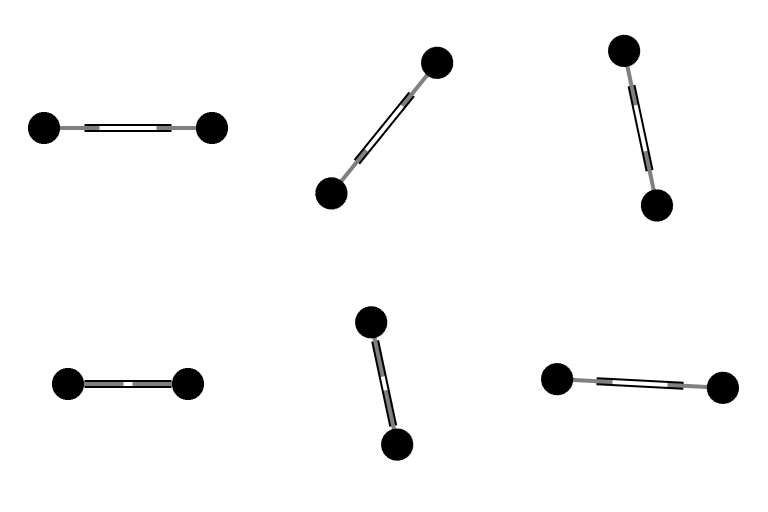
Two weights connected to pistons. Hydraulic machinery (not shown) pulls the weights closer to the center of rotation, causing angular acceleration.
When a rotating assembly is contracted the centripetal force is doing work. The work done increases the angular velocity. The angular velocity increases so much that for the contracted assembly the required centripetal force to sustain that higher angular velocity is larger than before.
As shown in animation 1.: as the sytem contracts the radius of circumnavigation decreases, but because of the increase in angular velocity the higher energy state requires a larger centripetal force in order to sustain circular motion.
The concept of doing negative work
First I need to discuss the concept of doing negative work. As an example I wil use the case of compressing a gas.
When you are compressing a gas you are doing work upon the gas, and potential energy accumulates.
Next: relax your effort to compress the gas, doing so gradually. As you let out the piston the gas reverts towards a less compressed state. Even though you are still exerting a force you allow the piston to move against the force you are exerting. That means: during the relaxation the force you are still exerting is doing negative work upon the gas.
Now: in the case of compressing a gas and relaxing again there is the option of describing the relaxation in terms of the pressure of the gas against the piston doing work.
However, in the case of the rotating assembly: to account for the energy conversions that take place using the concept of negative work is a necessity. In the process of contracting a rotating assembly and relaxing again there is at all times only a single force at play: the centripetal force. During relaxation of the rotating assembly the decrease of kinetic energy is accounted for in terms of the centripetal force doing negative work.
Moving down a ramp
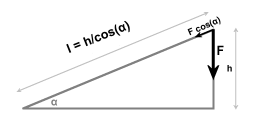
Sliding down a ramp or moving straight in the direction of the force results in the same amount of work done.
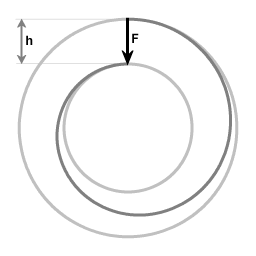
Moving along an inward spiral is like moving down a ramp.
Another analogy: moving along a spiral is like moving down a ramp.
Diagram 2 illustrates the case of moving down over a height h. The motion can be either straight down, parallel to the direction of the force, or the motion can be along a ramp. In both cases the final kinetic energy is the same. The presence of the ramp affects the direction of the final velocity, but for calculating the amount of work done you simply multiply the force F with height h.
Diagram 3 illustrates that an inward spiralling trajectory is like moving down a ramp. Initially the object is moving along the outer circle, then it's pulled closer to the center, settling on moving along the inner circle. It's not necessary to know the shape of the spiraling trajectory. The amount of work that is done is the force multiplied with the height difference h.
Uniform rate of contraction
The kinetic energy of an object in circular motion is \(\tfrac{1}{2} mr^2\omega^2\) where \(r\) is the radius and \(\omega\) is the angular velocity. At each distance \(r\) to the center of rotation the magnitude of the required centripetal force is \(m \omega^2r\).
Since both the kinetic energy and the required force are functions of \(r\) and \(\omega\) the relation must be stated in the form of a differential equation.
![\begin{array}{lcl} F & = & -m \omega^2 r \\[3pt] E_k & = & \tfrac{1}{2}mr^2\omega^2 \\[2pt] \cfrac{dE_k}{dr} } & = & F \end{array}](../momentum_img/20230807_142000_442x306.png)
The goal is to see whether the differential relation (1) can be narrowed down to a straightforward relation between \(r\) and \(\omega\)
Substituting the expressions for E and F into the differential relation gives:
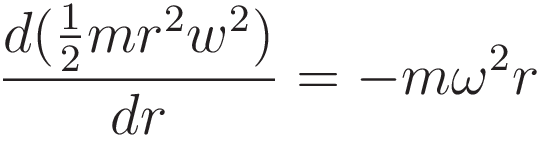
To go from (2) to (3) a substitution has been applied. With the substitution applied we see that the differentiation checks out.
The substitution that was applied:
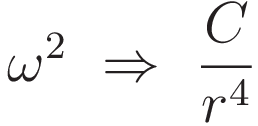
Where \(C\) is a constant.
(4) rearranges to \(\omega^2r^4 = C\) which simplifies to the expression for conservation of angular momentum:
The general case
In the general case at each point in time the centripetal force can be larger, equal to or smaller than the amount of force that is required for sustaining circular motion.
We take advantage of the fact that it is simple to decompose the kinetic energy into two perpendicular components: kinetic energy of motion in radial direction, and angular kinetic energy.

About the exerted force: at all times the magnitude of the required centripetal force is a function of \( r \) and \( \omega \): \(m \omega^2r\). When there is a surplus of centripetal force the object will accelerate inward, and with a deficit: outward.

Combining (6) and (7):

(8) can be seen as a combination of equations (9a) and (9b):


If the terms of component equation (9a) are equal then it follows that (9b) is valid as written.
Here I give the differentiation in a chained equation, confirming (9a). For discussion of the individual steps I refer to Appendix 1

The left hand side and the right side of (9a) are equal; it follows: no matter what the instantaneous radial acceleration is, inward or outward, at all times the motion will satisfy the relation (9b). (9b) is the same as (2).
This demonstrates that when a centripetal force is doing work the amount of work done is such that angular momentum is conserved.
Anytime there is radial velocity that velocity converts to angular velocity. The immediate effect of an increase of centripetal force is that the circumnavigating object acquires a radial velocity. A quarter of a turn later that radial velocity has transformed to circumnavigating velocity.
Cause and effect
This particular derivation is along lines of cause-and-effect: when a centripetal force is doing work, it causes angular acceleration. The amount of angular acceleration is such that a quantity proportional to \( \omega r^2 \) is conserved.
Symmetry
For any instantaneous orientation the reasoning is the same. We have that none of the reasoning involves an instantaneous angle \( \theta \). The expressions contain \( \omega \), the first time derivative of angle, but not angle itself. The conserved quantity angular momentum correlates with symmetry under spatial rotation.
Appendices
Appendix 1
Repeating (10), the verification of (9a)
The first step is the chain rule of differentiation:
the derivative of \( \tfrac{1}{2} m \left( \tfrac{dr}{dt} \right)^2 \) wrt \( \left( \tfrac{dr}{dt} \right) \), multiplied with the derivative of \( (\tfrac{dr}{dt}) \) wrt \( r \).
The second step looks like it could be an instance of abuse of notation:
One way to verify (A.1) is to evaluate the inverse: integrate \( \tfrac{d^2r}{dt^2} \) with respect to \( r \)
With:
\( a \) acceleration
\( v \) velocity
\( r \) radial distance
\( t \) time
First the substitution \( {dr = v \ dt} \) is applied, with corresponding change of limits, and then the substitution \( {a \ dt = dv} \) is applied, with corresponding change of limits.
With the intermediate steps omitted:
On the basis of the fundamental theorem of Calculus we know the inverse is valid:
And that confirms (A.1)
Appendix 2
The following demonstration is copied with minor changes from a post on physics stackexchange. The contributor who posted it uses the nick 'octonion'.
The question:
Angular momentum derivation without vector products
For a single particle in a central potential
With:
\( E \) Total energy
\( U(r) \) Potential as a function of radial distance
Apply the constraint: the derivative of the total energy with respect to time is zero.
What we need is a way to get to an expression of the following form:
To see if we can obtain a substitution that both results in an expression that contains \( \frac{d}{dt}(mr^2\omega) \) and enables simplification we execute that differentiation. That differentiation will give a term with \( \dot{\omega} \), which will give us a shot at eliminating \( \dot{\omega} \) from (A2.2).
To set up for substitution of the term that contains \( \dot{\omega} \): move the term \( 2mr\omega\dot{r} \) over to the other side.
In order to match the term with \( \dot{\omega} \) in (A2.2): multiply all the terms with \( \omega \):
with substitution according to (A2.6) we obtain from (A2.2):
The sum of rate of change of radial velocity and centripetal acceleration is equal to the exerted force.
The centripetal acceleration: \(a_c=-r\omega^2\)
Since \( F = -\frac{dU}{dr} \) the term in parentheses with \( U(r) \) in it is zero at all times, so that term drops away.
The remaining term simplifies to:

This work is licensed under a Creative Commons Attribution-ShareAlike 3.0 Unported License.