History
The hiatus in entries on this History page is not because no new content was added, I just neglected to document the changes.
Among those changes: the illustrations presented in the 'least action visualized' article were initially animated gifs. Those were replaced with graphlets (created using JSXGraph)
Around March 2020 the 'Least action visualized' article was overhauled, changing the content significantly. The new content added a crucial insight that makes Hamilton's stationary action entirely transparent.
Around December 2020 the article 'Energy-Position equation' was added, initially with one interactive diagram. That first interactive diagram was for the case of a potential that increases with the cube of the displacement. Around March 2021 I added two instances of the interactive diagram; one for the case of a potential that increases linear with height, and one for the case of a potential that increases quadratic with displacement (Hooke's law). Between those three diagrams all cases are covered.
The page 'Energy-Position equation' completes the objective of making Hamilton's stationary action entirely transparent.
In June 2021 the article 'Euler-Lagrange equation' was added. Some material that was previously in the 'least action visualized' article was moved there.
2013, October 20th
Up till now the EJS simulations were made available as browser applets. But the technology of Java-applets-in-the-browser has no future. For security reasons it is ill advised to enable Java-in-the-browser.
Java-applets-in-the-browser use NPAPI (Netscape Plugin Application Programming Interface), and Google has announced that in the course of 2014 they will remove support for the NPAPI in their browser Google Chrome: "Saying Goodbye to Our Old Friend NPAPI"
From the beginning I made the EJS simulations also available as standalone applets. Now the pages for each of the EJS simulations start with offering the link to download the standalone applet, and I have removed the instances of applet-in-the-browser.
So, to have both the applet and the webpage in view the applet and the browser will have to be positioned side by side. Most of the EJS simulations I created are 1000 pixels wide, so on many monitors there won't be much width left for the browser. That will rarely be a problem: the pages of my site still render very well in a narrow browser window. Try it! You can go to a very narrow browser window without getting a horizontal scroll bar.
2013, March 24th
A pair of interactive animations has been replaced. The new animations are: Coriolis effect and centrifugal effect. Visitors that use links to the previous pages are automatically redirected to the new animations.
The previous versions were created using the Physlets platform. The Physlets platform requires the Java browser plug-in. The new animations have been created using the Javascript library JSXGraph. These new animations do not require a plug-in; everything needed (Javascript, SVG) is already in the browser.
Rather than replacing the content of existing pages I moved the content. The previous animations were located in a directory called 'physlets', and the new animations aren't Physlets. ('Physlets' is a registered trademark.)
I'm going to call these kind of interactive animations 'graphlets'. I asked the creators of JSXGraph whether that's OK with them. Michael Gerhäuser, one of the developers, responded positively, saying he rather liked the term.
2012, February 5th
By coincidence a year after the previous entry on this history page: the article about Centrifugal force now has illustrating images.
Also, I'm in the process of adding some functionality. Previously the animations would loop infinitely. Now, the animations can be halted and restarted. (A Javascript function swaps the animation with a still image). It's in place now for the most frequently viewed articles.
2011, February 5th
A visitor, Damien Belliard, who has a meteorology website himself, offered to translate the 'Coriolis effect in meteorology' article into French, which I gratefully accepted. I can read French fairly well, so I'm happy to publish the translation on my own website. L'effet Coriolis en météorologie.
2010, November 5th
New article: I have replaced the existing article about least action with a completely new one. It's now titled Least action visualized. In classical mechanics the work-energy theorem and the principle of least action are mathematically equivalent. The purpose of the article is to show that as vivid as possible.
2010, October 2nd
New article: The least action approach.
Discussion of the 'principle of least action'.
2010, august 29th
New simulation: Force laws
The two long range forces of physics, newtonian gravity and the electrostatic force, are inverse square laws; their strength diminishes proportional to distance squared. what if there would be a force that diminishes proportional to the first power of distance? Or a force that is proportional to the inverse third power? Explore forces proportional to Rn, where n can be any number, not just integers.
2010, Juli 10th
New simulation: Ballistics
This simulaton is forked from the 'ballistics and orbits' simulation. This version works with the actual Earth radius, the actual Earth rotation rate, and the actual gravitational acceleration. It's a real time simulation. The simulation is designed for short trajectories over short distances, in the range of tens of meters to hundreds of kilometers.
2010, Januari 21st
No new content, but a change in presentation.
Until now I the pages on this site always used the full width of the browser's window. Recently I learned about the possibility of specifying a 'max-width' for any element on a webpage. I have specified for all pages a maximum width of 65 times the size of the font that the visitor is using. In other words, when the browser renders the page the width of the central column will be adjusted according to the size of the font that the visitor is using.
2009, December 13th
New article: Gyroscope physics
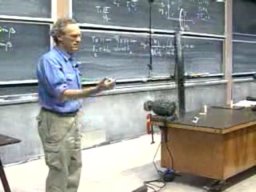
One of the evergreens of classical mechanics demonstrations is the behavior that can be elicited from a gyroscope. The picture is from the demonstration by professor Lewin. I discuss why the spinning bicycle wheel doesn't pitch down.
2009, December 4th
New simulation: Spacestation vertical throw
In science fiction movies rotation is sometimes used to create gravity inside a space station. If you throw an object, and you want it to land right at your feet again, in what direction do you need to aim?
With this interactive animation you can dial in angle and velocity and so on and then see where the objects ends up.
2009, September 20th
New simulation: Angular acceleration of a contracting system
A pair of masses is circumnavigating a vertical axis, in opposite positions. Strings that run over two opposite pulleys connect the circling masses to a downward pulling weight. As the rotating system contracts the centripetal force is doing work, and the circling masses accelerate.
When a rotating system has contracted to half its previous radius, ending once again in sustained circular motion, then the final centripetal force is 8 times stronger than at the original radius of motion. The simulation is designed to display that vividly.
2009, August 2nd
New article: Quantity of motion
Momentum and kinetic energy have in common that they express quantity of motion. In this article I discuss relations between symmetry principles and conservation principles, using only the examples of momentum and kinetic energy.
2009, July 30th
Ouch, I just learned a Google lesson the hard way.
I wanted the rotation of Earth effect in Meteorology article to be the first article that search engines offer when visitors have entered the search string "Coriolis effect". Well, I did manage to redirect the search result, but boy did it cost me. The Google ranking of the rotation of Earth effect in Meteorology page is way, way lower than what I had.
2009, July 20th
Supporting material: Foucault rod mathematics. Discussion of the mathematical setup of the Foucault rod simulation.
2009, July 19th
New article: Coriolis effect in Meteorology.
Actually this article does not present new content. The difference with existing articles is that I have avoided all math and I have used jargon as little as possible. It's a barebone introduction to the subject.
Generally the articles on this site are written for first year and second year students of Physics and the Earth sciences Meteorology and Oceanography. In the past months my site has entered the Top Ten of Search results in several search engines, so I felt that I should also prepare material for a wider audience. My aim is that search engines will put this article at the top of their search results for 'Coriolis effect'.
2009, July 8th
New simulation: Foucault rod
A rod with a bob at the end is vibrating. When the assembly circumnavigates there is Foucault turning in accordance with the sine law. The angle of the rod and the bob's distance to the central axis can be varied independently.
2009, April 4th
Section about relativity of simultaneity in the 'special relativity' article rewritten.
2009, March 28th
New simulation: Ballistics and orbits
The trajectory of a ballistic missile is a keplerian orbit. In this simulation projectiles can be fired straight up or at any other angle, thus showing the rotation-of-Earth effects that are at play.
2009, March 28th
At the occasion of adding a new simulation to my site I start a 'History' page. I am constantly doing minor edits, as they come along, but major additions to the site are few and far in between. On this page I will report the major additions, such as new articles, new simulations, or rewrites that alter the content. As usual on History pages the chronology of the entries is reversed, new entries are added at the top.
History before I started this page
I started this site in june 2006. The layout is inspired by Wikipedia. In particular I have copied the way that images are displayed on Wikipedia.
I started adding simulations in 2008. The simulations are created using Francisco Esquembre's open source tool EJS. The first two, 'Inertial oscillation' and 'Great circles' were completed in the summer of 2008. The simulations 'Circumnavigating pendulum' and 'Foucault pendulum' were added in january 2009, and shortly after that I also added full discussions of the mathematical setup of the Inertial oscillation and the Foucault pendulum simulations.
Also in january 2009 my first four EJS models were adopted in the Open source physics collection.
The Open Source physics section of the comPADRE website is, among other things, a repository for simulations with their documentation.
Proverbially, a picture says more than a thousend words. One might say that pictures add another dimension; in a sense text is one-dimensional. Animation plays a sequence of images, adding another dimension: the dimension of time. Finally, simulation brings in a whole new level by adding the dimension of user interaction. You can vary the input values, setting up all kinds of different scenarios.

This work is licensed under a Creative Commons Attribution-ShareAlike 3.0 Unported License.
Last time this page was modified: August 06 2021